U.S. government funds mosque renovation and rehabilitation around the world
By Caroline May - The Daily Caller 08/24/2010
While much attention has been focused on questions surrounding the Ground Zero mosque and the appropriateness of the State Department funding Ground Zero mosque imam Feisal Abdul Rauf’s trip to the Middle East, little attention has been given to the fact that U.S. taxpayer money is funding mosque development around the world.
Just a cursory search of the term “mosque” on the State Department’s list of “projects” reveals 26 examples of federal funds going to fund construction, renovation, and rehabilitation of various mosques abroad. The benefiting countries include Bulgaria, Pakistan, Mali, Tunisia, Afghanistan, Benin, Bosnia-Herzegovina, Albania, Egypt, Tunisia, the Maldives, Yemen, Turkmenistan, Tanzania, Uganda, Azerbaijan, Sudan, Serbia and Montenegro.
The U.S. Ambassadors Fund for Cultural Preservation (AFCP) — which is putting millions toward “heritage preservation” projects in the developing world — financed mosque-related projects in all the aforementioned countries.
In Montenegro, for example, the State Department has funded an effort to restore and conserve the Shadrvan (Fountain) of the Old Mosque in Pljevlja. According to the State Department’s website, without needed repairs there would not be a sufficient place for ritual washing before prayer.
“To support the restoration of a fountain at a 16th-century mosque concurrent with the restoration of the mosque itself. Used for ritual ablutions before prayer, the fountain has deteriorated over time and needs a new wooden octagonal roof, pipes, water-taps, and pavement,” the description of the project reads.
Nicole Thompson, a State Department spokeswoman, told The Daily Caller that the U.S. Ambassadors Fund for Cultural Preservation is a type of diplomatic effort and outreach, what she says Secretary of State Hillary Clinton calls “soft power.”
“It is helping to preserve our cultural heritage. It is not just to preserve religious structures,” Thompson said. “It is not to preserve a religion. It is to help us as global inhabitants preserve cultures.”
In a document provided on Monday to Indiana Republican Sen. Richard G. Lugar, ranking member of the Senate Committee on Foreign Relations, the State Department explained that the practice of funding such projects became acceptable in 2003 when the Justice Department declared that the U.S. Constitution’s Establishment Clause did not preclude federal funds from going to preserve religious structures if they had cultural importance.
The DOJ wrote: “That advice is provided in the following paragraph that appears in every AFCP request for grant proposals… ‘The establishment clause of the U.S. Constitution permits the government to include religious objects and sites within an aid program under certain conditions. For example, an item with a religious connection (including a place of worship) may be the subject of a cultural preservation grant if the item derives its primary significance and is nominated solely on the basis of architectural, artistic, historical or other cultural (not religious) criteria.’”
The United States Agency for International Development (USAID) has also spent millions reconstructing and financing multiple mosques in Cairo and Cyprus, as well as providing computers for imams in Tajikistan and Mali.
Interestingly, however, according to the Code of Federal Regulations, “USAID funds may not be used for the acquisition, construction, or rehabilitation of structures to the extent that those structures are used for inherently religious activities.”
USAID press officer Annette Aulton told TheDC that the code did not apply to the mosque construction and the imam computer projects as they were done for ostensibly secular concerns.
“Historic and cultural preservation activities have a clearly secular purpose as do activities to promote tourism,” Aulton wrote in an e-mail. “With respect to the computer center in the mosque in Tajikistan, this activity seems to be part of a larger program aimed at reducing social conflict.”
She continued, “[W]ith respect to the computer equipment provided to the Imam in Mali, there really isn’t enough information to do an analysis. There are references to promotion of the town’s historical, cultural and religious heritage, which sounds like a secular purpose.”
“I think it is disastrously wrongheaded and unconstitutional,” Robert Spencer, director of Jihad Watch, told TheDC in reference to the federal government’s funding of mosque renovation and rehabilitation abroad. “It is not going to accomplish what they hope it will. They are not going to win hearts and minds. It is not as if they are going to say ’the Americans built this mosque for us so we shouldn’t wage jihad on them.’”
Spencer went on to say that the State Department will often explain that it provides funds for cultural reasons, “but a mosque is a mosque is a mosque. It is where prayer happens. That is a religious instillation.”
Ibrahim Hooper of the Council on American-Islamic Relations (CAIR) disagreed, telling TheDC that such projects can help improve relations with the Muslim world.
“Anytime the United States is seen as being on the side of Muslims, of their aspirations and their needs and goals, that can only help our image and interests around the world,” he said.
Dr. Sayyid M. Syeed, national director of the Islamic Society of North America Office of Interfaith and Community Alliances, echoed Hooper’s sentiments, telling TheDC that it is worthwhile to preserve centuries old historical and cultural structures and funding these projects could help America build bridges in the Muslim world.
“It is an erroneous image that America is singling Muslims out as their target,” he said. “So to some extent this could help.”
But Michael Rubin, resident scholar at the American Enterprise Institute, noted to TheDC that such initiatives are problematic because they often lack oversight and “quality control.”
“Part of the problem is the State Department really has no definition of what radical means and they also have no coherent strategy when it comes to dealing with extremist Islam,” Rubin said. “As a result you have young junior officers who are adjudicating grants and are basically approving them on the basis of what the grantee says rather than doing a deeper check behind who they are affiliated with or what their mission is.”
He continued, “Unfortunately Muslim Brotherhood type groups are the ones which are the slickest when it comes to PR and have the greatest ability to reach out.”
Dr. Zuhdi Jasser, president and founder of the American Islamic Forum for Democracy, told TheDC that despite American efforts to reach out to Muslims around the world, a recent Zogby poll found that in the Muslim world, the percentage of the population which views America favorably still hovers around 18%.
“We have always felt this type of outreach is completely ineffective and that ultimately we have to approach it like the Cold War where we are fighting an ideology and we have to be poignantly open about what part of political Islam we are trying to change and modify,” Jasser said. “If we are going to have this long war of ideas we cannot fund these religious institutions. We can fund anti-Islamist institutions based in liberty.”
Herbert London, president of Hudson Institute, told TheDC that he is extremely troubled by the use of government funds for religious purposes. “I wouldn’t be okay with it if these were synagogues that they were funding,” he said.
According to the State Department’s disclosure to Sen. Lugar’s office, there are zero construction efforts occurring on historic Jewish synagogues, though there is funding of some Jewish related projects such as the “preservation of the Main Gate and Tombstones in the Jewish Cemetery in Sarajevo [Bosnia-Herzegovina].” The disclosure also shows examples of the State Department funding churches, cathedrals and Buddhist and Hindu temples abroad.
http://dailycaller.com/2010/08/24/u-s-government-funds-mosque-renovation-and-rehabilitation-around-the-world/print/#ixzz0xhsQRJXk
Thursday, August 26, 2010

Fortress Iran
The Geopolitics of Iran: Holding the Center of a Mountain Fortress
By George Friedman
To understand Iran, you must begin by understanding how large it is. Iran is the 17th largest country in world. It measures 1,684,000 square kilometers. That means that its territory is larger than the combined territories of France, Germany, the Netherlands, Belgium, Spain and Portugal - Western Europe. Iran is the 16th most populous country in the world, with about 70 million people. Its population is larger than the populations of either France or the United Kingdom.
Under the current circumstances, it might be useful to benchmark Iran against Iraq or Afghanistan. Iraq is 433,000 square kilometers, with about 25 million people, so Iran is roughly four times as large and three times as populous. Afghanistan is about 652,000 square kilometers, with a population of about 30 million. One way to look at it is that Iran is 68 percent larger than Iraq and Afghanistan combined, with 40 percent more population.
More important are its topographical barriers. Iran is defined, above all, by its mountains, which form its frontiers, enfold its cities and describe its historical heartland. To understand Iran, you must understand not only how large it is but also how mountainous it is.

Iran's most important mountains are the Zagros. They are a southern extension of the Caucasus, running about 900 miles from the northwestern border of Iran, which adjoins Turkey and Armenia, southeast toward Bandar Abbas on the Strait of Hormuz. The first 150 miles of Iran's western border is shared with Turkey. It is intensely mountainous on both sides. South of Turkey, the mountains on the western side of the border begin to diminish until they disappear altogether on the Iraqi side. From this point onward, south of the Kurdish regions, the land on the Iraqi side is increasingly flat, part of the Tigris-Euphrates basin. The Iranian side of the border is mountainous, beginning just a few miles east of the border. Iran has a mountainous border with Turkey, but mountains face a flat plain along the Iraq border. This is the historical frontier between Persia - the name of Iran until the early 20th century - and Mesopotamia ("land between two rivers"), as southern Iraq is called.
The one region of the western border that does not adhere to this model is in the extreme south, in the swamps where the Tigris and Euphrates rivers join to form the Shatt al-Arab waterway. There the Zagros swing southeast, and the southern border between Iran and Iraq zigzags south to the Shatt al-Arab, which flows south 125 miles through flat terrain to the Persian Gulf. To the east is the Iranian province of Khuzestan, populated by ethnic Arabs, not Persians. Given the swampy nature of the ground, it can be easily defended and gives Iran a buffer against any force from the west seeking to move along the coastal plain of Iran on the Persian Gulf.
Running east along the Caspian Sea are the Elburz Mountains, which serve as a mountain bridge between the Caucasus-Zagros range and Afghan mountains that eventually culminate in the Hindu Kush. The Elburz run along the southern coast of the Caspian to the Afghan border, buffering the Karakum Desert in Turkmenistan. Mountains of lesser elevations then swing down along the Afghan and Pakistani borders, almost to the Arabian Sea.
Iran has about 800 miles of coastline, roughly half along the eastern shore of the Persian Gulf, the rest along the Gulf of Oman. Its most important port, Bandar Abbas, is located on the Strait of Hormuz. There are no equivalent ports along the Gulf of Oman, and the Strait of Hormuz is extremely vulnerable to interdiction. Therefore, Iran is not a major maritime or naval power. It is and always has been a land power.
The center of Iran consists of two desert plateaus that are virtually uninhabited and uninhabitable. These are the Dasht-e Kavir, which stretches from Qom in the northwest nearly to the Afghan border, and the Dasht-e Lut, which extends south to Balochistan. The Dasht-e Kavir consists of a layer of salt covering thick mud, and it is easy to break through the salt layer and drown in the mud. It is one of the most miserable places on earth.
Iran's population is concentrated in its mountains, not in its lowlands, as with other countries. That's because its lowlands, with the exception of the southwest and the southeast (regions populated by non-Persians), are uninhabitable. Iran is a nation of 70 million mountain dwellers. Even its biggest city, Tehran, is in the foothills of towering mountains. Its population is in a belt stretching through the Zagros and Elbroz mountains on a line running from the eastern shore of the Caspian to the Strait of Hormuz. There is a secondary concentration of people to the northeast, centered on Mashhad. The rest of the country is lightly inhabited and almost impassable because of the salt-mud flats.
If you look carefully at a map of Iran, you can see that the western part of the country - the Zagros Mountains - is actually a land bridge for southern Asia. It is the only path between the Persian Gulf in the south and the Caspian Sea in the north. Iran is the route connecting the Indian subcontinent to the Mediterranean Sea. But because of its size and geography, Iran is not a country that can be easily traversed, much less conquered.
The location of Iran's oil fields is critical here, since oil remains its most important and most strategic export. Oil is to be found in three locations: The southwest is the major region, with lesser deposits along the Iraqi border in the north and one near Qom. The southwestern oil fields are an extension of the geological formation that created the oil fields in the Kurdish region of northern Iraq. Hence, the region east of the Shatt al-Arab is of critical importance to Iran. Iran has the third largest oil reserves in the world and is the world's fourth largest producer. Therefore, one would expect it to be one of the wealthiest countries in the world. It isn't.
Iran has the 28th largest economy in the world but ranks only 71st in per capita gross domestic product (as expressed in purchasing power). It ranks with countries like Belarus or Panama. Part of the reason is inefficiencies in the Iranian oil industry, the result of government policies. But there is a deeper geographic problem. Iran has a huge population mostly located in rugged mountains. Mountainous regions are rarely prosperous. The cost of transportation makes the development of industry difficult. Sparsely populated mountain regions are generally poor. Heavily populated mountain regions, when they exist, are much poorer.
Iran's geography and large population make substantial improvements in its economic life difficult. Unlike underpopulated and less geographically challenged countries such as Saudi Arabia and Kuwait, Iran cannot enjoy any shift in the underlying weakness of its economy brought on by higher oil prices and more production. The absence of inhabitable plains means that any industrial plant must develop in regions where the cost of infrastructure tends to undermine the benefits. Oil keeps Iran from sinking even deeper, but it alone cannot catapult Iran out of its condition.
The Broad Outline
Iran is a fortress. Surrounded on three sides by mountains and on the fourth by the ocean, with a wasteland at its center, Iran is extremely difficult to conquer. This was achieved once by the Mongols, who entered the country from the northeast. The Ottomans penetrated the Zagros Mountains and went northeast as far as the Caspian but made no attempt to move into the Persian heartland.
Iran is a mountainous country looking for inhabitable plains. There are none to the north, only more mountains and desert, or to the east, where Afghanistan's infrastructure is no more inviting. To the south there is only ocean. What plains there are in the region lie to the west, in modern-day Iraq and historical Mesopotamia and Babylon. If Iran could dominate these plains, and combine them with its own population, they would be the foundation of Iranian power.
Indeed, these plains were the foundation of the Persian Empire. The Persians originated in the Zagros Mountains as a warrior people. They built an empire by conquering the plains in the Tigris and Euphrates basin. They did this slowly, over an extended period at a time when there were no demarcated borders and they faced little resistance to the west. While it was difficult for a lowland people to attack through mountains, it was easier for a mountain-based people to descend to the plains. This combination of population and fertile plains allowed the Persians to expand.
Iran's attacking north or northwest into the Caucasus is impossible in force. The Russians, Turks and Iranians all ground to a halt along the current line in the 19th century; the country is so rugged that movement could be measured in yards rather than miles. Iran could attack northeast into Turkmenistan, but the land there is flat and brutal desert. The Iranians could move east into Afghanistan, but this would involve more mountain fighting for land of equally questionable value. Attacking west, into the Tigris and Euphrates river basin, and then moving to the Mediterranean, would seem doable. This was the path the Persians took when they created their empire and pushed all the way to Greece and Egypt.
In terms of expansion, the problem for Iran is its mountains. They are as effective a container as they are a defensive bulwark. Supporting an attacking force requires logistics, and pushing supplies through the Zagros in any great numbers is impossible. Unless the Persians can occupy and exploit Iraq, further expansion is impossible. In order to exploit Iraq, Iran needs a high degree of active cooperation from Iraqis. Otherwise, rather than converting Iraq's wealth into political and military power, the Iranians would succeed only in being bogged down in pacifying the Iraqis.
In order to move west, Iran would require the active cooperation of conquered nations. Any offensive will break down because of the challenges posed by the mountains in moving supplies. This is why the Persians created the type of empire they did. They allowed conquered nations a great deal of autonomy, respected their culture and made certain that these nations benefited from the Persian imperial system. Once they left the Zagros, the Persians could not afford to pacify an empire. They needed the wealth at minimal cost. And this has been the limit on Persian/Iranian power ever since. Recreating a relationship with the inhabitants of the Tigris and Euphrates basin - today's Iraq - is enormously difficult. Indeed, throughout most of history, the domination of the plains by Iran has been impossible. Other imperial powers - Alexandrian Greece, Rome, the Byzantines, Ottomans, British and Americans - have either seized the plains themselves or used them as a neutral buffer against the Persians.
Underlying the external problems of Iran is a severe internal problem. Mountains allow nations to protect themselves. Completely eradicating a culture is difficult. Therefore, most mountain regions of the world contain large numbers of national and ethnic groups that retain their own characteristics. This is commonplace in all mountainous regions. These groups resist absorption and annihilation. Although a Muslim state with a population that is 55 to 60 percent ethnically Persian, Iran is divided into a large number of ethnic groups. It is also divided between the vastly dominant Shia and the minority Sunnis, who are clustered in three areas of the country - the northeast, the northwest and the southeast. Any foreign power interested in Iran will use these ethnoreligious groups to create allies in Iran to undermine the power of the central government.
Thus, any Persian or Iranian government has as its first and primary strategic interest maintaining the internal integrity of the country against separatist groups. It is inevitable, therefore, for Iran to have a highly centralized government with an extremely strong security apparatus. For many countries, holding together its ethnic groups is important. For Iran it is essential because it has no room to retreat from its current lines and instability could undermine its entire security structure. Therefore, the Iranian central government will always face the problem of internal cohesion and will use its army and security forces for that purpose before any other.
Geopolitical Imperatives
For most countries, the first geographical imperative is to maintain internal cohesion. For Iran, it is to maintain secure borders, then secure the country internally. Without secure borders, Iran would be vulnerable to foreign powers that would continually try to manipulate its internal dynamics, destabilize its ruling regime and then exploit the resulting openings. Iran must first define the container and then control what it contains. Therefore, Iran's geopolitical imperatives:
1.Control the Zagros and Elburz mountains. These constitute the Iranian heartland and the buffers against attacks from the west and north.
2.Control the mountains to the east of the Dasht-e Kavir and Dasht-e Lut, from Mashhad to Zahedan to the Makran coast, protecting Iran's eastern frontiers with Pakistan and Afghanistan. Maintain a line as deep and as far north and west as possible in the Caucasus to limit Turkish and Russian threats. These are the secondary lines.
3.Secure a line on the Shatt al-Arab in order to protect the western coast of Iran on the Persian Gulf.
4.Control the divergent ethnic and religious elements in this box.
5.Protect the frontiers against potential threats, particularly major powers from outside the region.
Iran has achieved four of the five basic goals. It has created secure frontiers and is in control of the population inside the country. The greatest threat against Iran is the one it has faced since Alexander the Great - that posed by major powers outside the region. Historically, before deep-water navigation, Iran was the direct path to India for any Western power. In modern times, the Zagros remain the eastern anchor of Turkish power. Northern Iran blocks Russian expansion. And, of course, Iranian oil reserves make Iran attractive to contemporary great powers.
There are two traditional paths into Iran. The northeastern region is vulnerable to Central Asian powers while the western approach is the most-often used (or attempted). A direct assault through the Zagros Mountains is not feasible, as Saddam Hussein discovered in 1980. However, manipulating the ethnic groups inside Iran is possible. The British, for example, based in Iraq, were able to manipulate internal political divisions in Iran, as did the Soviets, to the point that Iran virtually lost its national sovereignty during World War II.
The greatest threat to Iran in recent centuries has been a foreign power dominating Iraq -Ottoman or British - and extending its power eastward not through main force but through subversion and political manipulation. The view of the contemporary Iranian government toward the United States is that, during the 1950s, it assumed Britain's role of using its position in Iraq to manipulate Iranian politics and elevate the shah to power.
The 1980-1988 war between Iran and Iraq was a terrific collision of two states, causing several million casualties on both sides. It also demonstrated two realities. The first is that a determined, well- funded, no-holds-barred assault from Mesopotamia against the Zagros Mountains will fail (albeit at an atrocious cost to the defender). The second is that, in the nation-state era, with fixed borders and standing armies, the logistical challenges posed by the Zagros make a major attack from Iran into Iraq equally impossible. There is a stalemate on that front. Nevertheless, from the Iranian point of view, the primary danger of Iraq is not direct attack but subversion. It is not only Iraq that worries them. Historically, Iranians also have been concerned about Russian manipulation and manipulation by the British and Russians through Afghanistan.
...For Iran, its ultimate problem is internal tensions. But even these are under control, primarily because of Iran's security system. Ever since the founding of the Persian Empire, the one thing that Iranians have been superb at is creating systems that both benefit other ethnic groups and punish them if they stray. That same mindset functions in Iran today in the powerful Ministry of Intelligence and Security and the elite Islamic Revolutionary Guards Corps (IRGC). (The Iranian military is configured mainly as an infantry force, with the regular army and IRGC ground forces together totaling about 450,000 troops, larger than all other service branches combined.)
Iran is, therefore, a self-contained entity. It is relatively poor, but it has superbly defensible borders and a disciplined central government with an excellent intelligence and internal security apparatus. Iran uses these same strengths to destabilize the American position (or that of any extraregional power) around it. Indeed, Iran is sufficiently secure that the positions of surrounding countries are more precarious than that of Iran. Iran is superb at low-cost, low- risk power projection using its covert capabilities. It is even better at blocking those of others. So long as the mountains are in Iranian hands, and the internal situation is controlled, Iran is a stable state, but one able to pose only a limited external threat.
The creation of an Iranian nuclear program serves two functions. First, if successful, it further deters external threats. Second, simply having the program enhances Iranian power. Since the consequences of a strike against these facilities are uncertain and raise the possibility of Iranian attempts at interdiction of oil from the Persian Gulf, the strategic risk to the attacker's economy discourages attack. The diplomatic route of trading the program for regional safety and power becomes more attractive than an attack against a potential threat in a country with a potent potential counter.
Iran is secure from conceivable invasion. It enhances this security by using two tactics. First, it creates uncertainty as to whether it has an offensive nuclear capability. Second, it projects a carefully honed image of ideological extremism that makes it appear unpredictable. It makes itself appear threatening and unstable. Paradoxically, this increases the caution used in dealing with it because the main option, an air attack, has historically been ineffective without a follow-on ground attack. If just nuclear facilities are attacked and the attack fails, Iranian reaction is unpredictable and potentially disproportionate. Iranian posturing enhances the uncertainty. The threat of an air attack is deterred by Iran's threat of an attack against sea-lanes. Such attacks would not be effective, but even a low-probability disruption of the world's oil supply is a risk not worth taking.
As always, the Persians face a major power prowling at the edges of their mountains. The mountains will protect them from main force but not from the threat of destabilization. Therefore, the Persians bind their nation together through a combination of political accommodation and repression.
http://www.marketoracle.co.uk/Article5606.html
What. I will have to pay for Health Care. I thought Obama was going to give it to me for FREE.
Beginning in 2014, U.S. citizens and legal
residents will be required to buy health insurance or pay a penalty. The penalty
will be phased in, beginning at the greater of $93.50 per person or 1 percent
of a person’s applicable household income that is in excess of the applicable
tax filing threshold in 2014 and increasing to the greater of $695 per person
or 2.5 percent of a person’s applicable household income that is in excess of
the applicable tax filing threshold in 2016. For persons under the age of 18,
the penalty is half of the above amount.
Individuals may be exempt from the mandate, for example, if they can’t find
affordable health insurance, as defined by the government, or if their income
does not meet the federal tax-filing threshold. In 2010, the threshold for
taxpayers under age 65 was $9,350 for singles and $18,700 for couples.
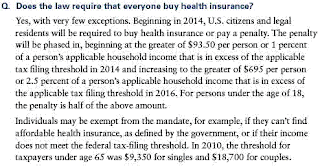
residents will be required to buy health insurance or pay a penalty. The penalty
will be phased in, beginning at the greater of $93.50 per person or 1 percent
of a person’s applicable household income that is in excess of the applicable
tax filing threshold in 2014 and increasing to the greater of $695 per person
or 2.5 percent of a person’s applicable household income that is in excess of
the applicable tax filing threshold in 2016. For persons under the age of 18,
the penalty is half of the above amount.
Individuals may be exempt from the mandate, for example, if they can’t find
affordable health insurance, as defined by the government, or if their income
does not meet the federal tax-filing threshold. In 2010, the threshold for
taxpayers under age 65 was $9,350 for singles and $18,700 for couples.

3 million Senors will see their prescription plan eliminated. How is that Hope and Change working for you.
More than 3 Million seniors may have to switch drug plans
By RICARDO ALONSO-ZALDIVAR (AP)
WASHINGTON — A plan by Medicare to try to make it simpler for consumers to pick drug coverage could force 3 million seniors to switch plans next year whether they like it or not, says an independent analysis.
That risks undercutting President Barack Obama's promise that people can keep their health plans if they like them.
And it could be an unwelcome surprise for many seniors who hadn't intended to make a change during Medicare's open enrollment season this fall.
The analysis by Avalere Health, a leading private research firm, estimated that more than 3 million beneficiaries will see their prescription plan eliminated as part of a new effort by Medicare to winnow down duplicative coverage and offer consumers more meaningful choices.
Seniors would not lose coverage, but they could see changes in their premiums and copayments.
Medicare officials dismissed the Avalere estimate without offering their own number. "Anybody who is producing that kind of analysis is simply guessing," said Jonathan Blum, deputy administrator for Medicare.
But Bonnie Washington, a senior analyst with Avalere, said the company's analysis used Medicare's specifications.
For example, Medicare has already notified insurers they will no longer be able to offer more than one "basic" drug plan in any given location. Several major prescription plans, including CVS-Caremark and AARP, offered two basic options throughout the country this year, Washington said. Eliminating that particular form of duplication among the top plans would force 2.75 million beneficiaries to find new coverage, according to Avalere's estimate.
When other changes are taken into account, as many as 3.7 million Medicare recipients may have to switch, the analysis concluded. That amounts to about 20 percent of the 17.5 million enrolled in stand-alone drug plans.
Avalere serves industry and government clients with in-depth research on Medicare and Medicaid. The company's president was a health care budget analyst in the Clinton White House.
Former Medicare administrator Leslie Norwalk said the change might make things easier for people signing up for Medicare but harder for those already in the program.
"If you're in a plan that you like and you have to change it, it will be disruptive," said Norwalk, acting administrator under President George W. Bush. "It depends on how (Medicare) handles it to try to make it as seamless as possible."
Reducing the number of Medicare drug plans has long been a goal for consumer advocates. This year, nearly 1,600 plans offered a dizzying range of options, many of which were not significantly different.
But Medicare is going ahead with the consolidation in a hard-fought election year. Republicans have barraged seniors with charges that Obama and the Democrats raided the program to expand coverage for younger generations under the health care overhaul. Obama's promise that people can keep health plans they like was made in the context of that broader debate, but the president has repeatedly assured seniors their Medicare benefits are safe.
"Some opponents of the (health care) law may say that this is taking away choices, but we have heard from our members for years that the (drug coverage) options can be confusing," said Nora Super, AARP's top health care lobbyist. The seniors lobby supports the change. AARP's public policy branch is separate from its business side, which sponsors Medicare and other insurance plans.
Medicare official Blum said the agency is working with insurers to keep disruptions to a minimum. For example, seniors could be automatically reassigned to a comparable plan offered by their insurance company. Premiums may not necessarily be any higher, Medicare officials said.
"We are not reducing the number of (insurers). We are not reducing the number of quality plans," said Blum, adding that having fewer, more distinct choices will benefit seniors. "That puts beneficiaries in a stronger, rather than weaker position."
Besides eliminating duplicative basic coverage, insurers that offer more than one enhanced coverage plan will have to show they are clearly different.
Medicare is expected to release its list of drug plans for 2011 late next month. Instead of 40 or more choices in each state, seniors may have around 30 plans to pick from.
http://www.google.com/hostednews/ap/article/ALeqM5j9a4NhJMu0YU4habnaMIAS1JbuLAD9HQC04G0
Democrats are spending the country into economic decline
The Wall Street Journal: "Now there are at least 14.5 million Americans still searching for work: 1.4 million of them have been jobless for more than 99 weeks, 6.5 million have been jobless for over 27 weeks. Step one for HOPE AND CHANGE is getting the congressional change in November.
OUTSIDE THE BOX -- AUGUST 25, 2010
Stop the Madness
By PETE DU PONT
http://online.wsj.com/article/SB10001424052748703447004575449961346648370.html?mod=googlenews_wsj
Summer is almost ended, and Americans are growing more and more skeptical about the coming fall--about our lack of jobs, our bigger and more expensive government, the higher taxes that will be coming soon, more expensive and less personal health care, and, most important, our declining economy.
A look at specific trends makes it seem very bad indeed. As Mortimer Zuckerman recently wrote in The Wall Street Journal: "Now there are at least 14.5 million Americans still searching for work: 1.4 million of them have been jobless for more than 99 weeks, 6.5 million have been jobless for over 27 weeks."
Pessimism is on the increase, and people are losing confidence in the president. In health care, while 39% of people believe Barack Obama's performance is up to expectations, 55% say that he has fallen short. Regarding our economy it is 29% positive and 66% negative. And the budget deficit? Only 25% of people think the government has done well controlling the deficit, while 67% believe it is too big and will not be cut.
Just two years ago, the total debt of the federal government was 69% of our gross domestic Product. Last year it was 83%; this year it has risen to 94%. By 2013 or 2014, if we continue current economic policies, it will exceed 100%. And those numbers don't even include the tens of trillions of dollars in Social Security and Medicare debts that are already with us.
If we continue the very large annual increases in federal spending that our current government has pushed--Washington is estimated to spend $30,543 per household this year, $5,000 more than two years ago--our economy will face serious decline, if not collapse. Michael Boskin, writing in February, cited a study that found a gross debt-to-GDP ratio of 30% to 90% would be sustainable. But the study concluded, in Mr. Boskin's words, "as it gets to 90% of GDP, there is a dramatic slowing of economic growth by at least one percentage point a year." This would mean higher interest rates, higher taxes and continued weakness in jobs and investment as the unsustainable deficits cast a pall over our economy.
So America needs a different and better national economic policy. First, our huge annual deficits ($1.47 trillion this year) must be substantially reduced, not expanded. As Jonathan Weisman noted in the Journal earlier this month, that is a very challenging task: Eliminate the military, federal education funding, agriculture support, housing programs, federal prisons, the FBI, Central Intelligence Agency, Coast Guard, and border patrols, and we would still have a deficit. And as Rep. Gary Peters (D., Mich.) has observed, "People say 'Don't touch my Social Security. Don't touch my Medicare. Don't cut defense spending. Don't raise my taxes.' " Nevertheless, it has to be done.
Second, tax rates must be reduced to promote economic growth. Start by not letting the Bush tax cuts expire next January, then repeal before their 2013 start date the ObamaCare 3.8% Medicare tax on investment income and the additional 0.9% Medicare tax on wages.
Third, reversing the current federal policy of growing the size and scope of government. Not enacting cap-and-trade would be a first step, one that Congress seems to have adopted already. Repealing ObamaCare is another, so that health-care costs are not massively increased--estimated by some to be $2 trillion in the first full decade--and so that individuals and their doctors can make their own medical choices.
With the huge increases in spending enacted in the last two years, it will be difficult to find a congressional consensus on spending reductions. If we cannot all agree, for example, that it's time to end federal subsidies for ethanol ($6 billion per year) and all manner of farm crop subsidies ($15 billion per year), we won't make any progress.
After November, there is likely to be an opportunity to accomplish some of these goals. The Democrats see their House control slipping, their Senate majority shrinking. And though they won't admit it, they know that the past 19 months of runaway growth in government have made millions of Americans more and more skeptical. People see endless growth of spending--the Office of Management and Budget shows deficit spending slightly declining for three or four years and then rising again beginning in 2015--and they expect big tax hikes to pay for it.
The time has come to stop the economic madness. Step one is getting the congressional change in November. Step two is for Republicans to step up to the plate and enact substantial spending and tax rate reductions and increase economic growth. And step three must be to win the presidency in 2012 so that the Obama governmental expansion comes to an end.
Wednesday, August 25, 2010
Shariah and the ground zero mosque
Mosque Controversy a 'Teachable Moment' on Shariah
Wednesday, 25 Aug 2010 10:01 AM Article Font Size
By: Frank Gaffney
http://www.newsmax.com/FrankGaffney/GaffneyShariahmosqueground/2010/08/25/id/368360 As I looked out at the thousands of people assembled near ground zero on Sunday to oppose the construction of a megamosque there, I was reminded of Winston Churchill's famous line that enspirited Britain at the first sign the tide was turning in World War II: "Now, this is not the end. It is not even the beginning of the end. But it is, perhaps, the end of the beginning."
To be sure, the rally held two blocks from the World Trade Center was not a decisive defeat of the enemy like that dealt by the storied British "Desert Rats" to Hitler's Afrika Korps in November 1942. But there was something pivotal about the fact that throngs of ordinary Americans — many of them family or friends of those who died on 9/11 — had come together to stand for hours in an intermittent rain not just to contest the construction of a megamosque at a wholly inappropriate location, but in informed opposition to the impetus behind that mosque: Shariah.
In fact, throughout the crowd could be seen signs with just the word "Shariah" lettered in dripping, blood-red ink. The prospect that the tide is beginning now to turn in our generation's war for the free world can be found in those signs.
They bespeak a recognition of the danger posed by the brutally repressive, totalitarian and anti-constitutional program that is espoused by the authorities of Islam. Shariah, the law of Saudi Arabia and Iran, is what Imam Feisal Abdul Rauf, the prime-mover behind the ground zero mosque, says he wants to "bring to America."
The assembled union workers, firefighters, police officers, Patriot Guard bikers and other regular folks were addressed by a succession of citizen activists, community leaders, and 9/11 family members. The thunderous response to patriotic speeches and songs about freedom and the threat posed to it by people like those who toppled the once-adjacent World Trade Center rang in the canyons of Lower Manhattan and — due to the massive media presence — across the land.
When my turn came to speak, I actually thanked Imam Rauf. For, in his overreaching ambition to build what he first dubbed the "ground zero mosque," Rauf unwittingly and unintentionally created a "teachable moment" about Shariah, and what he and others like him are doing to insinuate it into this country.
As a result most especially of President Obama's ill-advised decision on August 13th to embroil himself in the debate over the mosque, millions of Americans are now opposing its construction in proximity to some of our most hallowed ground.
Our countrymen are also becoming more knowledgeable about Shariah and why simply moving this advocate and his Islamic "cultural center" complex a few blocks away will not mitigate the danger they pose.
Specifically, the public is learning of the obligation on Shariah's adherents to impose this toxic program everywhere via jihad — holy war, waged by violence or by stealth. Thanks to the ground zero mosque controversy, Americans are also getting a crash-course on the preeminent perpetrator of the stealthy form of "civilization jihad," the Muslim Brotherhood.
While its tactics may differ from, say, al-Qaida's, the Brotherhood's objectives are identical: the supremacy of Islam and the establishment of a theocratic ruler, the caliph, who is to govern worldwide in accordance with Shariah.
As spokesmen from various Brotherhood front groups (notably, the Council on American Islamic Relations, the Muslim American Society and the Muslim Public Affairs Council) have been vociferously demanding that the construction of a megamosque is a test of our religious tolerance, more and more of us are realizing that this is what is known in Shariah as taqqiya, lying for the faith.
The crowd on Sunday understood that, no matter how often the Brotherhood's operatives and their non-Muslim apologists and enablers assert otherwise, the United States is not intolerant of the practice of Islam; the hundred or so mosques in New York City alone attest to that. Rather, the Brothers endlessly make such claims as part of the stealth jihad. Their playbook calls for them cynically to use our civil liberties to suppress opposition to the insinuation here of the most intolerant doctrine of all: Shariah.
As public awareness of and concern about Shariah intensifies, the Muslim Brotherhood and its friends are employing taqqiya frantically in the hope of maintaining the obscuration so critical to their stealth jihad. Notably, on the margins of Sunday's event, Salam al-Marayati of the Muslim Public Affairs Council — who attended Obama's iftar dinner on the 13th — tried to deflect criticism of Shariah, saying it is subject to various interpretations.
He and his friends would have us believe that the jihad it orders means nothing more than "internal struggle" to practice one's faith properly. Some, like Feisal Rauf, go so far as to insist that Shariah is compatible with the U.S. Constitution.
Fortunately, not all Muslims adhere to or seek to impose Shariah. If we start in a concerted way to empower those that do not, and effectively counter those — like the Muslim Brotherhood — that do, we may just be at the end of the beginning of this war to keep America Shariah-free.
http://www.newsmax.com/FrankGaffney/GaffneyShariahmosqueground/2010/08/25/id/368360
Hindenburg Omen hit twice in Aug 2010 how is that Hope and Change Working for you
http://thenewsoftoday.com/the-hindenburg-omen-is-the-a-stock-crash-coming/1526/
The “Hindenburg Omen,” basically is sparked when several market conditions meet up, and in many cases it ends in a stock market crash. In order for the Hindenburg Omen to be reached, all of the following must occur:
* The daily number of NYSE new 52-week highs and the daily number of new 52-week lows are both greater than or equal to 2.8% of NYSE issues trading that day.
* The NYSE’s 10-day moving average is rising, or the index has moved higher during the past 50 trading days.
* The McClellan Oscillator is negative on the same day. This is the the difference between the advancing and declining equities on the NYSE.
* New 52-week highs cannot be more than twice the new 52- week lows (though new 52-week lows may be more than double new highs).
The criteria above for the omen has actually been met twice, once on August 12th, and another time last Friday the 20th. Despite this, all the doom and gloom of yet another stock market crash may be unwarranted. Even though the Hindenburg Omen has predicted every stock crash since 1987, it also has a ton of false positives. Only about 25% of the time does it actually foretell a crash. Some analysts even argue that the Omen actually was not triggered, because most of the NYSE new highs were not on common stocks, rather preferred stocks and other forms of fixed income products.
Bam’s lousy economic record: Let’s just look at the facts, shall we?By Keith Hennessey
On the campaign trail, President Obama is talking about everything except his own economic record. He attacks his predecessor — a man for whom I worked — as his advisers promise a return to Clinton-era economics.
Rather than hearing about the last two Presidents, voters may instead want the President to explain the economic realities of his own 18-month tenure and what he foresees for the next two years. To further that understanding here are some facts.
At 9.5%, the unemployment rate is 1.8 percentage points higher today than when the President took office. There are 3.3 million fewer U.S. jobs than there were in January 2009. The U.S. economy has lost jobs in 12 of the 18 months he has been office, including the last two months.
In early August of last year, the President declared that, thanks in part to his policies, the U.S. economy was “pointed in the right direction.” We have lost jobs in six of the 12 months since then, for a net decline of 52,000 jobs. The 9.4% unemployment rate when he made this statement climbed to 10.1% and has since declined to 9.5%, still higher than it was last August.
The President signed into law an $862 billion stimulus law and two health laws that will create $788 billion of new entitlements over the next decade. Combine these with countless other smaller spending bills, several of which were labeled as emergencies and therefore not paid for, and the U.S. government is $2.5 trillion more in debt than on the day this President took office. That’s $8,000 more debt for every American man, woman, and child.
Signed free trade agreements with allies Colombia, Panama, and Korea have not been ratified by Congress because the President has not submitted them for approval. For 18 months, all three have sat in his inbox.
That’s the past and present. What, then, does the President have to offer a skeptical voter for the future?
Assuming his economic agenda is enacted into law, the Obama administration projects unemployment would average 9.0% over four years of the President’s term. If you assume he is re-elected, they project unemployment over his two terms would average 7.6%.
For comparison, unemployment during former President Bill Clinton’s tenure averaged 5.2% and during President George W. Bush’s tenure it averaged 5.3%. Former President Jimmy Carter’s unemployment rate averaged 6.5%.
Treasury Secretary Timothy Geithner says the President is returning America to “the pro-growth tax and fiscal policies” of the Clinton administration. Yet the nonpartisan Congressional Budget Office estimates this administration would have the federal government spend more than 24% of the overall U.S. economy over his term, a government 25% larger than during the Clinton era. Budget deficits would average 8.7% of the U.S. economy, compared to Clinton’s average 0.4% surplus.
The President proposes more government spending, higher tax rates and more debt than his Democratic predecessor.
If Americans had devoted all their income from the beginning of 2009 to June 8 of that year, they could have paid off the government debt inherited by this President from all his predecessors. Under the President’s policies, if they were to try this in 2013, they’d have to work until Sept. 24 9 .
While attention focused on taxpayer funds invested in big Wall Street banks, Fannie Mae and Freddie Mac cost taxpayers $291 billion last year and will cost an additional $98 billion over the next decade. The new financial reform law does not address these two firms, which continue to cost taxpayers about $2 billion each month.
If the President has his way, on Jan. 1, taxes on many successful small business owners will rise. Investors will pay higher taxes on their capital gains and dividends, and some small businesses and family farms will once again be subject to death taxes. This isn’t undoing tax cuts for the rich, it’s raising taxes on small businesses.
Tanning salons and tobacco are not the only new taxes Americans will face. Drug companies, health plans and medical device manufacturers will charge higher prices as they pass new taxes on to their customers. Health Savings Accounts will no longer be usable for tax-free purchases of over-the-counter medications. Some workers will pay higher Medicare taxes, and some investors will pay a new 2.9% 3.8% tax.
Individuals and families who cannot afford health insurance will face a new tax, as will employers who cannot afford to provide their employees with health insurance. The President proposes to tax charitable contributions for high-income donors, American firms competing with foreign firms overseas, and, indirectly, your electric bill.
These facts may explain why President Obama wants to talk about somebody else.
--------------------------------------------------------------------------------
Backup and Sources•Unemployment rate = 9.5% in July 2010. Source: Bureau of Labor Statistics.
•Unemployment rate = 7.7% in January 2009. 9.5 – 7.7 = 1.8. Source: Bureau of Labor Statistics.
•In January 2009, total nonfarm payroll employment = 133.549 M. In July 2010, total nonfarm payroll employment = 130.242 M. The delta is 3.307 M. Source: Bureau of Labor Statistics. (Select More Formatting Options, then choose “Original Data Value” and Retrieve Data.
•Count the months that are negative, starting with the data point for February 2009. June and July 2010 are negative. Source: Bureau of Labor Statistics.
•“Today we’re pointed in the right direction.” Presidential Rose Garden statement, August 7, 2009.
•Count the months that are negative, starting with the data point for August 2009, the first one after this statement. Source: Bureau of Labor Statistics.
•In July 2009 (the data point for the Presidential statement), total nonfarm payroll employment = 130.294 m. In July 2010, total nonfarm payroll employment = 130.242 M. The delta is –52 K. Source: Bureau of Labor Statistics. (Select More Formatting Options, then choose “Original Data Value” and Retrieve Data.)
•Unemployment rate = 9.4% in July 2009, the data point for which the President made his “pointed” statement. The rate climbed to 10.1% in October 2009, and was 9.5% in the latest report for July 2010. Source: Bureau of Labor Statistics.
•“All told, CBO now anticipates that the law will increase deficits by $862 billion between 2009 and 2019.” Source: Congressional Budget Office, The Budget and Economic Outlook: Fiscal Years 2010 to 2020, Appendix A.
•For the $788 B figure I included only the net deficit impact of the new insurance coverage provisions. I could have chosen a larger number to incorporate other deficit-increasing provisions. Source: Congressional Budget Office, Score of H.R. 4872 in a letter to Speaker Pelosi, Table 1 on page 5.
•Debt held by the public on January 20, 2009: $6,307 B. Debt held by the public on August 12, 2010: $8,787 B. The delta is $2.48 trillion. Source: TreasuryDirect.
•U.S. population = 310 M. $2.48 T / 310 M = $8,000 per person. Source: Census.
•The Colombia Free Trade Agreement was signed on November 22, 2006. “Colombia’s Congress approved the agreement and a protocol of amendment in 2007. Colombia’s Constitutional Court completed its review in July 2008, and concluded that the Agreement conforms to Colombia’s Constitution.” Source: U.S. Trade Representative.
•The Panama Free Trade Agreement was signed on June 28, 2007. Panama approved the TPA on July 11, 2007. Source: U.S. Trade Representative.
•The Korea Free Trade Agreement was signed on June 30, 2007. “If approved, the Agreement would be the United States’ most commercially significant free trade agreement in more than 16 years.” Source: U.S. Trade Representative.
•The Administration’s projected annual average unemployment rates are: 2009 = 9.3%, 2010 = 9.7%, 2011 = 9.0%, 2012 = 8.1%. These average to 9.025%. Source: Office of Management and Budget, Mid-Session Review, Fiscal Year 2011, Table 2 on page 9.
•The same table shows projected annual average unemployment rates are: 2013 = 7.1%, 2014 = 6.3%, 2015 = 5.7%, 2013 = 5.3%. The eight-year average is 7.5625%. Source: Office of Management and Budget, Mid-Session Review, Fiscal Year 2011, Table 2 on page 9.
•Clinton average is calculated from February 1993 through January 2001. Bush average is calculated using February 2001 through January 2009. Carter average is calculated using February 1977 through January 1980. Source: Bureau of Labor Statistics.
•“Rather than creating a false prosperity fueled by debt and passing the bills on to the next generation, we need to restore America to a pro-growth tax and fiscal policy, …” Treasury Secretary Timothy Geithner, Remarks as prepared for delivery at the Center for American Progress, August 4, 2010.
•CBO estimates outlays/GDP ratios: 2009 = 24.7%, 2010 = 24.8%, 2011 = 25.4%, 2012 = 23.7%. These average to 24.65%. Source: Congressional Budget Office, An Analysis of the President’s Budgetary Proposals for Fiscal Year 2011, Table 1-2 on page 5.
•Outlays / GDP averaged 19.6% during the Clinton Administration. Source: My post Comparing Obama Economics to Clinton economics. Note this table shows a lower average for President Obama’s average spending because it uses the Administration’s more optimistic OMB projections. For an apples-to-apples comparison here I’m using CBO numbers.
•CBO estimates deficit/GDP ratios: 2009 = 9.9%, 2010 = 10.3%, 2011 = 8.9%, 2012 = 5.8%. These average to 8.725%. Source: Congressional Budget Office, An Analysis of the President’s Budgetary Proposals for Fiscal Year 2011, Table 1-2 on page 5.
•Source: My post Comparing Obama Economics to Clinton economics, which uses data from OMB’s Historical Table 1.2.
•Source: My post Comparing Obama Economics to Clinton economics. Revenues/GDP are projected to be lower during President Obama’s term because of the weak economy, but beginning in 2013 the top income tax rate will be higher than during the Clinton Administration.
•Debt held by the public on January 20, 2009 = $6,307 B. 2009 GDP = 14,119 B. Therefore debt / GDP = 44.67%. Assuming a linear GDP throughout the year, June 8th is 44.67% through the calendar year. Source: TreasuryDirect and Commerce Department, Bureau of Economic Analysis.
•I made an error here – it should be September 9th rather than September 24th. CBO projects debt held by the public at the end of CY 2012 = 11.579 T and projects 2013 GDP = 16.676 T. Therefore debt / GDP = 69.44%, getting to September 9, 2013.
•Source: Congressional Budget Office, CBO’s Budgetary Treatment of Treatment of Fannie Mae and Freddie Mac (January 2010), Table 2 on page 8.
•Source: Treasury’s “Green Book,” General Explanations of the Administration’s Fiscal Year 2011 Revenue Proposals, pp. 127-128.
•Source: Treasury’s “Green Book,” p. 131.
•Source: Treasury’s “Green Book,” p. i footnote 1.
•Section 5000B as added by Sec. 10907 of Public Law 111-148 (H.R. 3590), “Imposition of tax on indoor tanning services.”
•Section 701 of Public Law 111-3 (H.R. 2), “Increase in excise tax rate on tobacco products.”
•Section 9008 of Public Law 111-148 (H.R. 3590), “Imposition of annual fee on branded prescription pharmaceutical manufacturers and importers.”
•Section 9010 of Public Law 111-148 (H.R. 3590), “Imposition of annual fee on health insurance providers.”
•Section 9009 of Public Law 111-148 (H.R. 3590), “Imposition of annual fee on medical device manufacturers and importers.”
•Section 9003 of Public Law 111-148 (H.R. 3590), “Distributions for medicine qualified only if for prescribed drug or insulin.”
•Section 9015 of Public Law 111-148 (H.R. 3590), “Additional hospital insurance tax on high-income taxpayers.”
•Chapter 2A as added by Section 1402 of Public Law 111-152 (H.R. 4872), “Unearned income Medicare contribution.”
•Section 5000A(b) & (c) as added by Sec. 1501(b) of Public Law 111-148 (H.R. 3590), “Shared Responsibility Payment” and “Amount of penalty.”
•Sec. 1513 of Public Law 111-148 (H.R. 3590), “Shared responsibility for employers.”
•Source: Treasury’s “Green Book,” p. 129.
•Source: Treasury’s “Green Book,” throughout pp. 39-49.
•Source: The President’s Budget would establish “emissions allowances” from an economy-wide carbon cap. A cap-and-trade is economically equivalent to a carbon tax with some of the revenues raised rebated to carbon producers. Source: The President’s Budget, FY 2011, Table S-2, footnote 3 on p. 4.
http://keithhennessey.com/2010/08/16/obama-economy-facts/
------
U.S. Housing Market Holocaust, Existing Home Sales Crash / Housing-Market / US Housing
By: Mike_Whitney
Don't look now, but someone just pushed the housing market off a cliff. The National Association of Realtors announced on Tuesday that the sales of existing homes fell a staggering 27.2 percent to a seasonably adjusted rate of 3.83 million units. This is the lowest number of sales since 1995. The reaction on Wall Street has been swift, shares plunged in a wild sell-off that pushed stocks down more than 100 points in a matter of minutes. US Treasuries rallied on the news sending bond yields lower as jittery investors sought safety from the ongoing avalanche of dismal economic data. The 10-year slid to 2.49% while the 2 year note dipped to 0.46%. Bond yields are a gauge of investor pessimism. At present, confidence in the management of the economy is at its nadir.
------------
http://www.bullionbullscanada.com/index.php?option=com_content&view=article&id=14746:us-government-prepares-for-crisis&catid=47:us-commentary&Itemid=132
Given that at least some elements of the U.S. government have known all along that the U.S. economy was not “recovering” and could not recover, why is it that only now are we hearing of tentative, new plans of more “life support” for the dying U.S. economy?
The answer is also obvious. As I pointed out when I originally denounced the Obama “stimulus package”, it was never anything more than a bad joke. The combination of the collapse of the U.S. housing sector, massive unemployment, and the largest credit-contraction in the history of the U.S. economy had combined to subtract approximately $2 trillion per year in consumer spending from this consumer economy.
The response of the Obama regime to this scenario was a one-time injection of $780 in “stimulus”, spread-out over more than a year. Obviously, you can’t replace $2 trillion with less than $800 billion and call it “stimulus”.
This brings us to the present dilemma of the U.S. government. The U.S. economy is much sicker than it was when Obama ascended the throne. Wall Street has continued to ruthlessly choke-off all credit to the U.S. economy, meaning that tens of millions of American households, and tens of thousands of businesses are much closer to the breaking-point than they were in January of 2009.
The entire U.S. retail sector is in a terminal death-spiral, and its only response is to eliminate vast numbers of retail outlets, and herd consumers into more on-line retailing. While this “cuts costs” for these companies, most of those cuts will be reduced employment – fueling the next leg lower for consumer demand, resulting in even more store-closures, etc, etc.
This means that the trivial “band-aids” being mused-about by government talking-heads are utterly meaningless. Simply, the Obama regime has to “go big, or go home”. It must either engage in massive (genuine) “stimulus” of the U.S. economy – meaning a multi-trillion dollar commitment, or simply allow the collapse to proceed (and feed upon itself). However, in even contemplating another, massive wave of spending, Obama faces two other problems (which he created for himself).
Throughout this “U.S. economic recovery”, the U.S. government has continued to pretend that it was “almost ready” to begin some actual, fiscal restraint – halting the exponential increase in federal government debt. That was the only thing propping-up the U.S. dollar (putting aside the constant Euro-bashing by the U.S. propaganda-machine). Allow another sickening plunge in the U.S. dollar, and that will drive away the last, few chumps still insane enough to buy grossly over-priced U.S. Treasuries. This is the road that leads to hyperinflation.
http://www.bullionbullscanada.com/index.php?option=com_content&view=article&id=14746:us-government-prepares-for-crisis&catid=47:us-commentary&Itemid=132
Subscribe to:
Posts (Atom)